70% of Enterprise Transformations Fail. 👉 Here's Why.
Most transformation programs don’t fail because of execution. They fail because the target, priorities, and constraints change faster than the program can adapt.
Most transformation programs are delivered as planned. They still don’t deliver the expected outcomes. Not because execution is weak, but because the conditions the plan was built on don’t hold long enough.
📌 Priorities shift.
📌 New initiatives are added.
📌 Dependencies increase.
The program continues, but the gap between what was planned and what is needed keeps growing.
What this looks like in practice

Employee willingness to support change dropped from 74% → 38%
Only 20% of organizations realize >75% of projected transformation value
Employees are now handling 5× more change
(2 → 10 initiatives per year)
83% of workers report burnout symptoms
Why Transformation Keeps Breaking Down
-
Why programs fall short even when delivery is on track
(you deliver what was planned, but the business has already moved on) -
Where the current transformation model breaks down
(fixed roadmaps don’t hold when priorities keep changing) -
Why multiple initiatives create conflicts during delivery
(teams are pulled in different directions at the same time) -
How too much change impacts adoption and execution
(the same teams are expected to absorb everything, which slows delivery) -
What a more practical approach looks like
(shorter cycles, continuous adjustment, and better alignment with reality)
In this guide,
you’ll learn:
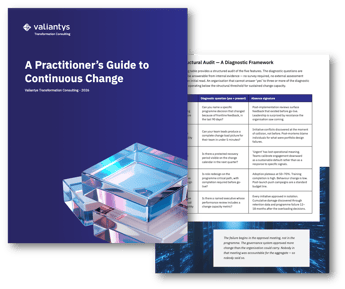
Why transformation fatigue is becoming a structural business problem
The 5 features of “change-fit” organizations
Why AI is making transformation harder before it makes it easier
How leading enterprises are shifting from project-based change to continuous transformation
How to assess your organization’s change capacity
/contegix-2023/Untitled%20design%20(53).png)