Service Management has traditionally been viewed as an “IT thing.” For years, IT carried the responsibility of structuring processes, managing requests, and keeping operations predictable, mostly because technology was at the center of so many workplace issues. Frameworks like ITIL came out of that pressure, helping IT get organized and deliver services more consistently.
But if you look at how work gets done today, it’s obvious that the same patterns show up well outside IT. HR, Finance, Facilities, Payroll, Legal, these teams deal with requests, approvals, cases, hand-offs, and SLAs every day. Some people even joke that if ITIL were being invented now, it would probably be called ESIL (Enterprise Service Infrastructure Library) because the principles apply across the whole business.
This idea connects directly to something we touched on in our earlier discussion about mid-market CIOs rethinking ITSM: organizations are moving away from reactive, siloed operations and toward more structured, consistent ways of working. And this shift isn’t limited to IT anymore. Leaders are starting to realize that if these principles helped IT reduce friction, they can help everyone else too.
That’s essentially what Atlassian means by a Connected System of Work, different teams using different tools, but still operating inside the same overall workflow fabric. And one of the clearest places where this connected model comes to life is in Human Resources (HR).
Why HR Has Become the Natural Entry Point for ESM
In our earlier conversation about how mid-market CIOs are rethinking ITSM, we talked about a shift from reactive operations to more structured, predictable ways of working. That shift isn’t confined to IT anymore. Leadership teams are realizing that if those practices helped IT mature, the same principles can help every department reduce friction.
And HR is often the first place they look.
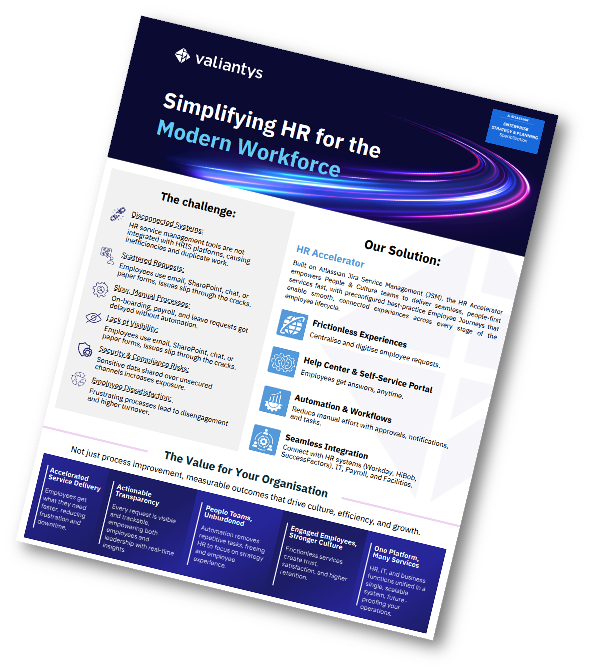
Most HR teams rely on a mix of email, spreadsheets, chat messages, and an HRIS. Those systems of record (like Workday or HiBob) are essential, but they’re not designed to manage the day-to-day, cross-functional work HR handles.
And that work touches almost every corner of the organization, especially when it involves:
- Onboarding and off-boarding
- Employee relations and case management
- Policy questions
- Compliance reviews
- Job changes, promotions, and approvals
Each of these processes requires input from IT, Facilities, Payroll, Finance, Legal, Security, or all of the above. When every team uses different systems with no shared workflow, things get messy. Delays pile up. Ownership gets fuzzy. Employees get frustrated.
This is exactly the type of gap ESM is meant to solve. In other words, the problem isn’t that HR tools are bad, it’s that the work stretches across teams with no shared system to hold it together.
Atlassian refers to this shared layer as a Connected System of Work.
How JSM Supports a More Connected System of Work
Atlassian describes this idea as a Connected System of Work, teams using tools that fit their needs, while still working within the same operational fabric. HR is one of the clearest examples of where this connected structure has immediate impact.
Three things are driving that momentum:
1. HR processes almost never happen in isolation
Onboarding requires IT for access and Facilities for workspace.
A job change requires Finance for budgeting.
An off-boarding requires Security for identity changes.
A shared system makes these dependencies visible instead of lost in email threads.
2. Leaders want more predictability and fewer one-off workflows
Consistent employee experiences matter.
Executives want to know who owns what.
A simple, structured service model gives HR the backbone it needs without overcomplicating things.
3. AI and automation work better when processes are structured
HR teams experimenting with virtual agents, routing rules, or summarization quickly learn that you can’t automate what you can’t see.
Structured workflows make AI genuinely useful.
How HR Accelerates Enterprise Service Adoption
Once HR adopts a connected service model, other teams start to feel the impact immediately. What begins as an HR initiative often becomes the spark for broader ESM adoption because HR’s improvements are visible across the business.
Organizations often start to build:
- A unified service portal
- A consistent intake experience across departments
- Clear ownership of cross-functional workflows
- Shared reporting and insights
- Stronger governance through aligned processes
The key is that none of these improvements require replacing existing systems. HR keeps the HRIS, Finance keeps its financial tools, and IT keeps its identity systems. The magic happens in the shared operational layer that ties everything together.
This is the core of the Connected System of Work, teams operating differently, but still moving together.
What Organizations Start to Notice
Once HR begins working inside a more connected system, the ripple effects show up almost immediately, often in places teams didn’t expect.
-
IT, for example, suddenly has a clearer view of who needs access to what, and when. No more scrambling on day one because the laptop wasn’t provisioned or the account wasn’t created.
-
Facilities gets earlier visibility into workspace needs, equipment requests, badge access changes, all the things that used to surface at the last minute.
-
Finance starts seeing cleaner approval trails and better alignment with budget owners because the whole request path is captured in one place.
-
Security benefits too. Identity-related activity, new hires, role changes, off-boarding, becomes more predictable and easier to audit when it flows through consistent workflows instead of scattered emails.
And HRIS data? It finally connects to the day-to-day work happening across teams. Instead of being a static record, it becomes the trigger for the operational processes that actually affect employees.
This is where the shift really clicks for leaders: ESM isn’t about forcing everyone onto a single platform. It’s about giving teams a shared way to coordinate work they’re already doing together.
HR just happens to be the place where you can see the value of that alignment fastest.
Conclusion: HR as a Catalyst for Enterprise Alignment
The shift from ITSM to ESM is driven by a desire to reduce operational friction, not by a need to roll out more tools. HR, with its high-impact processes and deep dependencies across the organization, offers a practical, meaningful place to begin.
By implementing a structured system of work that supports HR and connects it to IT, Facilities, Finance, Security, and other teams, organizations move closer to the connected, predictable operating model they’ve been aiming for.
This isn’t about modernizing HR alone.
It’s about building a connected system of work for the entire enterprise, and HR is uniquely positioned to lead the way.
Start Your HR Transformation
Discover how your HR team can deliver faster, seamless service with AI-powered workflows.