

Technology leaders already know the importance of cloud and AI adoption. But adoption is not the same as transformation.
As organizations use AI to build on their cloud migrations, a significant readiness gap becomes clear: investment in these technologies continues to grow, but it has not consistently translated into tangible business value.
Valiantys’ newest report, Why Enterprises Won Cloud Adoption but Risk Losing AI, explores the barriers preventing organizations from scaling AI and delivering successful technology transformation. Conducted by Omdia and commissioned by Valiantys and Atlassian, the research is based on a survey of 400 enterprise technology leaders across six countries. It offers insight into the challenges organizations face and what leaders see as necessary to move from adoption to lasting business value.
The research also provides the starting point for Enterprise Transformation in Action, a global Valiantys initiative exploring how organizations can connect strategy, governance, cloud modernization, and AI to measurable business outcomes.
Fragmentation Is Where Transformation Stalls
Cloud migration has long been touted as the solution to silos, inefficiencies, overspend, and tool sprawl. But the report shows that moving systems to the cloud has not consistently resolved these issues. Often, this comes down to implementation.
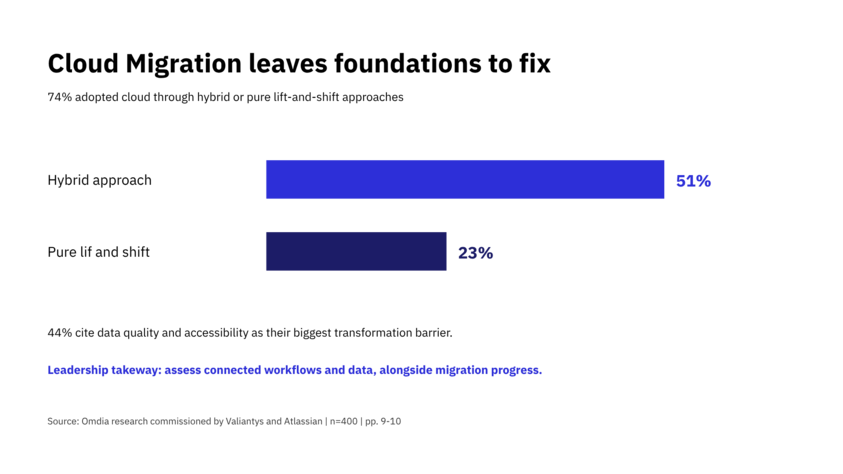
The report found that 74% of businesses adopted cloud through a hybrid approach (51%) or a pure “lift-and-shift” method (23%). These approaches can support immediate cost and speed goals, but migrating systems does not automatically connect applications, data, or workflows.
Fragmentation remains evident: 56% of organizations report that the average employee still relies on seven or more tools each week. Roughly half also describe their core systems as operating independently, with manual workarounds required to connect key systems. For these organizations, moving to the cloud has not fundamentally resolved fragmentation; it has relocated it.
Against this backdrop, only about 28% of organizations deliver expected outcomes on more than half of their transformation initiatives. Only 11% are predominantly or fully cloud-based, with more than 75% of their workloads in the cloud. For technology leaders, this means true transformation goes beyond adopting more technology. It requires organizations to build the foundations and operating model that make lasting outcomes possible.
AI Adoption Is Widespread. AI Readiness Isn’t.
Technology fragmentation isn’t just a cost and complexity problem. Without a solid foundation in place, it becomes increasingly difficult to implement and scale new tools, technology, and AI.
.png?width=843&height=474&name=Cloud%20Migration%20leaves%20foundations%20to%20fix%20(1).png)
The report highlights an AI readiness gap. Although AI use is widespread, readiness and maturity remain limited: 69% of organizations already use AI, but only 3% consider themselves fully ready for it. Additionally, 98% have an AI initiative underway, but only 2% describe AI as mature and integrated across the organization.
Moving from pilot to production remains a challenge: 35% of organizations are in pilot or proof-of-concept, while just 7% have reached a scaling phase. The foundational data, integration, and governance needed to scale AI matter, but barriers also extend beyond technology. Unclear ownership, skill gaps, and difficulty measuring outcomes can make it just as challenging to move AI initiatives forward.
Cloud Maturity Supports AI Advantage
Cloud migration is one step in digital transformation. To unlock greater value from AI and technology investments, organizations need to optimize their cloud environments. This means strengthening governance and data foundations, improving cost visibility, and connecting workflows across the enterprise that make it easier for AI to deliver measurable results.
This requires a sustained transformation effort. When asked to describe their strategic focus for the next two to three years, 33% of survey respondents indicated cloud optimization with AI integration was their focus. While this is a step in the right direction, execution remains the main challenge. To be successful, leaders need a transformation roadmap that clearly assesses the organization’s current state and defines priorities, ownership, and measurable outcomes.
Measurement is part of that work: 52% say formal ROI is how they would ideally measure AI value, but only 21% currently use formal ROI calculations. Agreeing a baseline, an accountable owner, and success measures helps leaders decide what to improve or scale.
.png?width=843&height=474&name=Cloud%20Migration%20leaves%20foundations%20to%20fix%20(3).png)
With this, organizations can strengthen the foundations needed to reach cloud maturity and scale AI, turning AI ambition and digital transformation into measurable value.
Technology Transformation Needs the Right Partner
Turning technology investments into lasting business value requires more than technology alone. Organizations create value when people, processes, data, governance, technology, and skills work together through a connected operating model. This means fixing the foundations, optimizing the environment and governance, and building the capability to scale AI and new ways of working across the enterprise.
Businesses also recognize that collaboration plays an important role in building this model. Sixty-four percent of organizations name collaborative transformation, where internal teams partner with external experts, as their preferred approach to technology transformation. Only 2% wish to remain fully internal.
Survey respondents identify industry expertise, proven experience, cloud and AI skills, and knowledge transfer among the most important capabilities they seek. This highlights the importance of technical expertise alongside the ability to build lasting capabilities within organizations.
.png?width=1920&height=1080&name=Cloud%20Migration%20leaves%20foundations%20to%20fix%20(4).png)
Turning these findings into action requires a clear connection between strategy and how work gets done. Transformation priorities need to translate into shared ownership, connected workflows, and effective delivery, supported by reliable data, governance, and skills. The report’s executive roadmap offers three practical priorities for building that connection:
Fix Foundations: Address people and process silos, improve data quality, and consolidate tools where duplication creates friction. This creates a more connected environment in which teams can work effectively and AI can draw on reliable information.
Optimize: Improve cloud environments, strengthen governance, and implement measurement frameworks. This helps organizations understand what is delivering value, improve what isn’t, and make informed decisions about where to invest next.
Scale: Develop internal capability, bring in specialist expertise where needed, and extend AI across functions. This helps organizations move beyond isolated initiatives and embed new capabilities and ways of working across the enterprise.
Together, these priorities give leaders a practical way to connect transformation ambitions with execution. The starting point will differ by organization: some will need to address fragmented data and workflows, while others will need clearer governance, stronger skills, or better measures of value.
As leaders consider their next steps, a few questions can help them assess their progress:
- Are our cloud investments changing how work gets done?
- Which processes still rely on manual workarounds?
- Are teams working toward shared priorities, or are initiatives still occurring in silos?
- Do we have the governance, skills, and ownership needed to scale AI?
- Can we measure whether our investments are delivering meaningful value?
- What is preventing pilots from moving into production?
These questions are central to Enterprise Transformation in Action: understanding where progress is constrained and identifying what needs to change across people, processes, data, and technology.
While the path forward will look different for every organization, the goal is the same: turning cloud and AI investments into lasting business value.
For the full findings and an executive roadmap for assessing readiness, strengthening governance, and measuring value, download Why Enterprises Won Cloud Adoption but Risk Losing AI. Explore Enterprise Transformation in Action to connect these findings to your organization’s next transformation priorities.